Politeness

Bob Turner
August 13, 2026
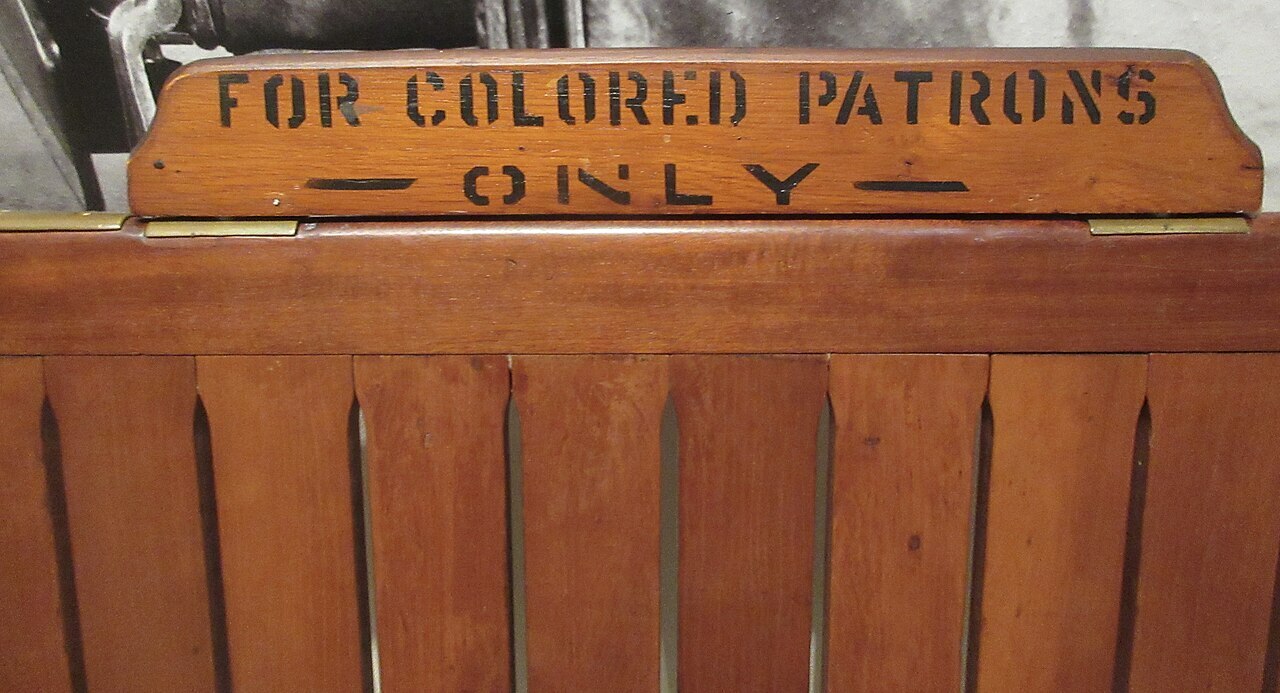
"New Orleans Public Service Streetcar Bench with Colored Segregation Sign" by Infrogmation of New Orleans is a Creative Commons image licensed under CC BY-SA 4.0
Pierce Pettis will be with us this weekend, and I want to encourage you to come to church for the show and to bring your family and friends. Pettis is a folk artist, but he’s so much more than that. He writes stunningly beautiful songs, and he plays guitar like a master. If he plays his instrumental, “Granddaddy Blew the Whistle,” on Saturday night, be careful that you don’t fall out of your chair. This will be a family-friendly show, but Pettis’s material is not childish. He addresses complex themes and adult emotions and motivations, even in a song that looks back on his own time as a child, such as “Alabama 1959.”
Pettis is a proud son of Alabama, which he calls in another song a “State of Grace,” but he has never shied away from the complicated nature of his heritage. “Alabama 1959” starts out on a nostalgic note, with the present-day narrator pulling out some old home movies to watch—“Daddy had hair, Mom was thin; / look at the silly clothes they wore back then”—but it soon takes a turn as it considers the darker undercurrents of that time and place. “Football games beneath the lights; / no one ever dared to cross the color line. / Black faces watched through the fence outside / in Alabama, 1959.” An easy enough observation to make about the racial tensions of his childhood, but Pettis proves his depth and subtlety with what comes next.
“‘Don’t use that word,’ my mother said. / ‘It isn’t Christian; call them colored folks instead.’” A deceptively simple pair of lines, but they serve merely as left-handed jabs to set up the knockout blow in the next couplet. He sings, “So I learned to be polite / in Alabama, 1959.” Bam! and you hit the canvas, blown away by the profundity of these few words.
So I learned to be polite. It wasn’t right for a white person to use the word for black people that the narrator had used as a child, so his Christian mother taught him how to be more respectful, more polite. But she didn’t teach him how to be just, and that is what the God that Christians worship calls for us to be. Being polite is precisely the wrong lesson to draw from one’s encounter with racial injustice; it whitewashes a house that really needs to be taken down to the foundation and rebuilt. When you use a polite word for a group of people instead of a slur or epithet, you can congratulate yourself and feel you are being “Christian” when in fact you have done nothing to address the real evil of racism. We have too many “polite” Christians who pat themselves on the back for their high-mindedness but who let slide or even perpetuate racial discrimination. We had too many in Alabama in 1959, and we have too many in Pennsylvania (and the rest of the country) in 2026.
This is not to condemn the narrator’s mother. She was steeped in a culture that was based on white supremacy and its counterpart, black inferiority. It is to her credit that she was “Christian” enough to demand that her son stop using defamatory words for their black neighbors. But that credit stretches only so far, and the time must come when we no longer accept politeness as a sufficient response to injustice. It’s not enough to refrain from racial slurs. It’s not enough to give lip service to the idea of racial harmony. It’s not enough to be polite when what is needed is a wholesale reordering of society—the abolition of racial profiling and police brutality, the reform of lending and hiring practices that discriminate against people of color, the removal of ghetto conditions and food deserts in neighborhoods where minorities live, the building of affordable housing, the expansion of public transportation options, and so on.
There are so many ways we can practice justice and promote equity—the list I just offered barely scratched the surface. Let’s think about what we can do as individuals and as a congregation to right some of the wrongs that still force black and brown people to “watch through the fence outside” in a figurative sense.
That is the behavior of a Christian, and it holds so much more power than a bland and anemic politeness that glosses over differences but changes nothing.
Pierce Pettis is coming. I hope you will join us as we welcome this poet and truth-teller to our church Saturday evening at 7:30.

-
Community UCC
-
Schwarzwald UCC
-
Trinity UCC
Office Hours
Contact
© 2026 Community UCC. All Rights Reserved.
|
Login
powered by
Website Developed by Tithely